
Reading list
69 texts and 4 films from 27 writers and speakers. Browse by subject, or start with a thinker. If you are new, begin with Start Here.
By subject
Start Here
Six texts that give you the whole shape of the theory. Begin here.
-
The founding statement: class struggle as the motor of history, and the case for the working class taking power.
Read on marxists.org -
Where wages come from and why they never buy back what workers produce. The shortest way into Marx’s economics.
Read on marxists.org -
Engels separates scientific socialism from wishful utopias and introduces dialectical materialism.
Read on marxists.org -
What the state is, why it cannot simply be taken over, and what replaces it.
Read on marxists.org -
Lectures setting out Leninism as the Marxism of the era of imperialism.
Read on marxists.org -
How knowledge comes from practice and returns to it.
Read on marxists.org -
A systematic survey of Marxist philosophy, political economy and socialism.
Read on marxists.org
Political Economy
How capitalism works, from the wage to the world market.
-
Where wages come from and why they never buy back what workers produce. The shortest way into Marx’s economics.
Read on marxists.org -
A talk to the First International on why wage struggles alone cannot end exploitation.
Read on marxists.org -
The full anatomy of capitalist production: the commodity, surplus value and accumulation.
Read on marxists.org -
How capitalism turned into monopoly, finance capital and the division of the world.
Read on marxists.org -
Marx’s reply to Proudhon, and his first published sketch of a materialist political economy.
Read on marxists.org -
The circulation of capital: how value is realised and how the economy reproduces itself. Edited by Engels.
Read on marxists.org -
Capital as a whole: profit and its falling rate, credit, rent and crisis. Edited by Engels.
Read on marxists.org -
The notebooks in which Marx worked out Capital: money, capital, machinery and the shape of history.
Read on marxists.org -
A section of the Grundrisse on the forms of property that came before capitalism, and how they dissolved.
Read on marxists.org -
Sometimes called Capital’s fourth volume: Marx’s critical history of political economy before him.
Read on marxists.org -
Lenin’s economic study showing capitalism already transforming the Russian countryside.
Read on marxists.org -
The law of value and commodity production under socialism.
Read on marxists.org -
How a planned economy could work, using modern computing and labour-time accounting. Free from the authors.
Read on users.wfu.edu · PDF
Philosophy
Dialectical and historical materialism: the method underneath everything else.
-
Engels separates scientific socialism from wishful utopias and introduces dialectical materialism.
Read on marxists.org -
Eleven short theses, ending with the line that the point is to change the world.
Read on marxists.org -
A short account of how Marxism grew out of Hegel and Feuerbach, and where it broke with them.
Read on marxists.org -
The first full statement of historical materialism: material life shapes consciousness.
Read on marxists.org -
A compact primer on the philosophy of Marxism.
Read on marxists.org -
How knowledge comes from practice and returns to it.
Read on marxists.org -
Contradiction as the driving force of every process.
Read on marxists.org -
A systematic survey of Marxist philosophy, political economy and socialism.
Read on marxists.org -
The young Marx on alienated labour: how wage work estranges people from what they make, from each other and from themselves.
Read on marxists.org -
Marx settles accounts with Hegel’s theory of the state, and turns from philosophy towards the critique of politics.
Read on marxists.org -
Marx and Engels’ first joint book: a polemic against the idealism of the Young Hegelians.
Read on marxists.org -
A defence of materialism against the philosophical fashions of the day.
Read on marxists.org -
A short fragment from Lenin’s philosophical notebooks on the unity and struggle of opposites.
Read on marxists.org -
Engels’ unfinished work on dialectics in the natural sciences, published long after his death.
Read on marxists.org -
Telling contradictions with enemies apart from contradictions among the people, under socialism.
Read on marxists.org
Party & State
Organisation, power, and what to do with the state.
-
The founding statement: class struggle as the motor of history, and the case for the working class taking power.
Read on marxists.org -
What the state is, why it cannot simply be taken over, and what replaces it.
Read on marxists.org -
The case for a disciplined party of professional revolutionaries.
Read on marxists.org -
The Paris Commune, the first workers’ government, and what it taught about the state.
Read on marxists.org -
Notes on a socialist party’s programme, with Marx’s clearest remarks on the transition to communism.
Read on marxists.org -
Lectures setting out Leninism as the Marxism of the era of imperialism.
Read on marxists.org -
A warning against ultra-left purity: work in the unions, use parliament, build the mass base.
Read on marxists.org -
The answer to Bernstein: reform without revolution leaves capitalism standing.
Read on marxists.org -
Gramsci greets the October Revolution as a break with the mechanical, wait-for-history reading of Marx.
Read on marxists.org -
Written in Turin’s factory-council movement: how workers’ own organisations can become the basis of a new state.
Read on marxists.org -
Co-founder of the Italian Communist Party, on hegemony, the party and intellectuals, much of it written in Mussolini’s prisons.
Read on marxists.org -
Che on building socialism: changing the economy is not enough without new social relations and a new consciousness.
Read on marxists.org -
Speech delivered at National Conference of Agricultural Workers - February 7, 1969
Read on marxists.org
Liberation
Women’s liberation, national liberation and the colonial question.
-
How private property, the family and the state arose, and the material roots of women’s oppression.
Read on marxists.org -
How socialism transforms housework, childcare and the family.
Read on marxists.org -
Kollontai against bourgeois feminism: why women’s liberation is bound up with working-class struggle.
Read on marxists.org -
Why the right of oppressed nations to secede is a working-class question.
Read on marxists.org -
A definition of the nation, and the Bolshevik approach to national oppression.
Read on marxists.org -
A programme for revolution in a semi-colonial country.
Read on marxists.org -
How Lenin’s writing on the colonies won a young nationalist to communism.
Read on marxists.org -
Irish socialist and leader of the 1916 Rising, on labour, Ireland and British rule.
Read on marxists.org -
Leader of Guinea-Bissau’s liberation struggle, on national liberation, culture and “the weapon of theory”.
Read on marxists.org -
The founder of Peru’s Communist Party applies Marxism to the land question and Indigenous Peru.
Read on marxists.org -
Castro’s defence speech after the Moncada attack, setting out the programme of the Cuban Revolution.
Read on marxists.org -
Speeches and writings, from History Will Absolve Me onwards.
Read on marxists.org -
Che’s call to the peoples of Asia, Africa and Latin America to confront imperialism together: “two, three, many Vietnams”.
Read on marxists.org -
Writings and speeches of the Cuban Revolution’s internationalist, including Socialism and Man in Cuba.
Read on marxists.org
History
Revolutions, crises and the working class, told by the people who took part or took sides.
-
Engels’ first-hand study of Manchester’s mills and slums: the founding portrait of the British working class.
Read on marxists.org -
The 1848 revolution in France, read as a struggle between classes rather than personalities.
Read on marxists.org -
How a coup made a mediocrity emperor: the classic analysis of class, the state and political crisis.
Read on marxists.org -
Fascism as capital’s last line of defence, and what was lost when the socialist states fell.
Find in a library -
A people’s history of the Third World project, from Bandung to the debt crisis.
Find in a library
Sources of Marxism
What Marx and Engels were reading and answering: German philosophy, British political economy and French socialism.
-
God as humanity’s own nature projected outwards: the materialism Marx and Engels started from.
Read on marxists.org -
The shorter version of Hegel’s logic, and the easier way in.
Read on marxists.org -
Consciousness developing through conflict and contradiction, including the master–servant dialectic.
Read on marxists.org -
Hegel’s logic of being, essence and concept, which Lenin read closely in 1914.
Read on marxists.org -
The founding work of British political economy, and the labour theory of value that Marx took up and criticised.
Read on marxists.org -
The utopian socialist whose attack on “civilisation” Engels admired: the French-socialist source.
Read on marxists.org -
A study of kinship and early societies that Engels drew on for The Origin of the Family.
Read on marxists.org
Textbooks
Soviet study manuals that set out the whole system in one place. Best once you have read some of the classics.
-
The Soviet manual that sets out the whole system, from philosophy to the building of communism, in one volume.
Read on bannedthought.net · PDF -
The standard Soviet university textbook of dialectical and historical materialism. Copy hosted by Midwestern Marx.
Read on midwesternmarx.com · PDF
Watch
Lectures and documentaries.
-
Burkina Faso’s revolutionary president, his programme, and his assassination in 1987.
Watch on YouTube -
The singer, actor and campaigner blacklisted in the United States, and loved by the miners of South Wales.
Watch on YouTube -
A recording of Parenti speaking in 1986.
Watch on YouTube -
A paragraph-by-paragraph commentary in half-hour parts. A companion for reading the Phenomenology.
Watch on YouTube
By thinker
-

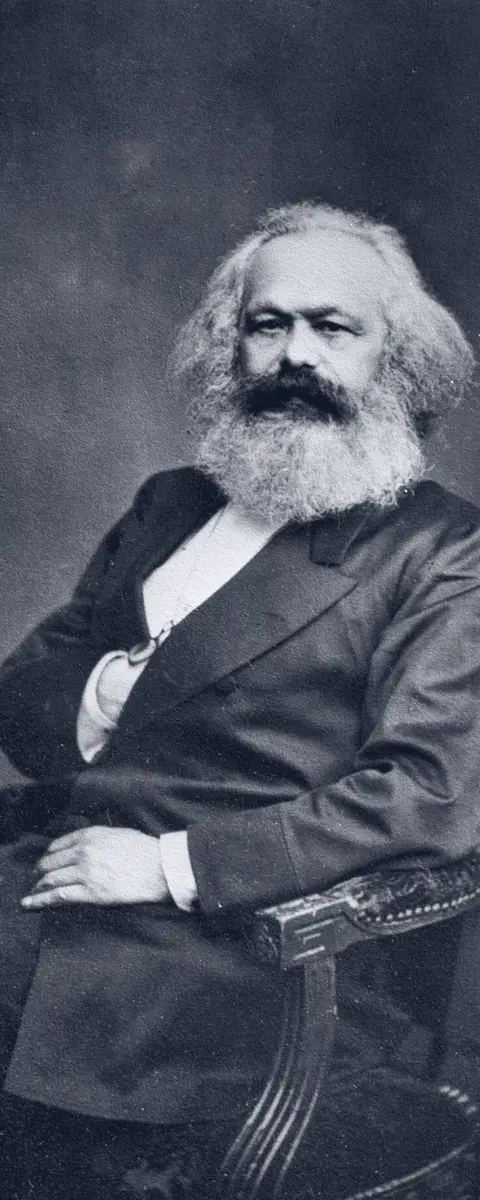
Karl Marx
1818–1883 · 19 textsFounder, with Engels, of scientific socialism and the critique of political economy.
Photo: John Jabez Edwin Mayall, before 1875 · Public domain · Commons
Read in this order-
The founding statement: class struggle as the motor of history, and the case for the working class taking power.
Read on marxists.org -
Where wages come from and why they never buy back what workers produce. The shortest way into Marx’s economics.
Read on marxists.org -
A talk to the First International on why wage struggles alone cannot end exploitation.
Read on marxists.org -
Eleven short theses, ending with the line that the point is to change the world.
Read on marxists.org -
The first full statement of historical materialism: material life shapes consciousness.
Read on marxists.org -
How a coup made a mediocrity emperor: the classic analysis of class, the state and political crisis.
Read on marxists.org -
The Paris Commune, the first workers’ government, and what it taught about the state.
Read on marxists.org -
Notes on a socialist party’s programme, with Marx’s clearest remarks on the transition to communism.
Read on marxists.org -
The full anatomy of capitalist production: the commodity, surplus value and accumulation.
Read on marxists.org -
The 1848 revolution in France, read as a struggle between classes rather than personalities.
Read on marxists.org -
The young Marx on alienated labour: how wage work estranges people from what they make, from each other and from themselves.
Read on marxists.org -
Marx settles accounts with Hegel’s theory of the state, and turns from philosophy towards the critique of politics.
Read on marxists.org -
Marx and Engels’ first joint book: a polemic against the idealism of the Young Hegelians.
Read on marxists.org -
Marx’s reply to Proudhon, and his first published sketch of a materialist political economy.
Read on marxists.org -
The notebooks in which Marx worked out Capital: money, capital, machinery and the shape of history.
Read on marxists.org -
A section of the Grundrisse on the forms of property that came before capitalism, and how they dissolved.
Read on marxists.org -
The circulation of capital: how value is realised and how the economy reproduces itself. Edited by Engels.
Read on marxists.org -
Capital as a whole: profit and its falling rate, credit, rent and crisis. Edited by Engels.
Read on marxists.org -
Sometimes called Capital’s fourth volume: Marx’s critical history of political economy before him.
Read on marxists.org
-
-


Friedrich Engels
1820–1895 · 9 textsMarx's collaborator, and the clearest explainer of their method.
Photo: William Hall, 1877 · Public domain · Commons
Read in this order-
Engels separates scientific socialism from wishful utopias and introduces dialectical materialism.
Read on marxists.org -
Engels’ first-hand study of Manchester’s mills and slums: the founding portrait of the British working class.
Read on marxists.org -
How private property, the family and the state arose, and the material roots of women’s oppression.
Read on marxists.org -
A short account of how Marxism grew out of Hegel and Feuerbach, and where it broke with them.
Read on marxists.org -
The founding statement: class struggle as the motor of history, and the case for the working class taking power.
Read on marxists.org -
The first full statement of historical materialism: material life shapes consciousness.
Read on marxists.org -
A systematic survey of Marxist philosophy, political economy and socialism.
Read on marxists.org -
Marx and Engels’ first joint book: a polemic against the idealism of the Young Hegelians.
Read on marxists.org -
Engels’ unfinished work on dialectics in the natural sciences, published long after his death.
Read on marxists.org
-
-


V. I. Lenin
1870–1924 · 8 textsLed the October Revolution; developed Marxism for the era of imperialism.
Photo: Pavel Zhukov, 1920 · Public domain · Commons
Read in this order-
What the state is, why it cannot simply be taken over, and what replaces it.
Read on marxists.org -
How capitalism turned into monopoly, finance capital and the division of the world.
Read on marxists.org -
The case for a disciplined party of professional revolutionaries.
Read on marxists.org -
A warning against ultra-left purity: work in the unions, use parliament, build the mass base.
Read on marxists.org -
Why the right of oppressed nations to secede is a working-class question.
Read on marxists.org -
A defence of materialism against the philosophical fashions of the day.
Read on marxists.org -
Lenin’s economic study showing capitalism already transforming the Russian countryside.
Read on marxists.org -
A short fragment from Lenin’s philosophical notebooks on the unity and struggle of opposites.
Read on marxists.org
-
-


J. V. Stalin
1878–1953 · 4 textsSystematised Leninism; led the USSR through industrialisation and the war.
Photo: Unknown photographer, 1937 · Public domain · Commons
Read in this order-
Lectures setting out Leninism as the Marxism of the era of imperialism.
Read on marxists.org -
A definition of the nation, and the Bolshevik approach to national oppression.
Read on marxists.org -
A compact primer on the philosophy of Marxism.
Read on marxists.org -
The law of value and commodity production under socialism.
Read on marxists.org
-
-


Mao Zedong
1893–1976 · 4 textsLed the Chinese Revolution; wrote on practice, contradiction and protracted war.
Photo: Chen Zhengqing, 1950 · Public domain · Commons
Read in this order-
How knowledge comes from practice and returns to it.
Read on marxists.org -
Contradiction as the driving force of every process.
Read on marxists.org -
A programme for revolution in a semi-colonial country.
Read on marxists.org -
Telling contradictions with enemies apart from contradictions among the people, under socialism.
Read on marxists.org
-
-


Ho Chi Minh
1890–1969 · 1 textFounder of the Vietnamese communist movement and its war of national liberation.
Photo: Unknown photographer, c. 1946 · Public domain · Commons
Read in this order-
How Lenin’s writing on the colonies won a young nationalist to communism.
Read on marxists.org
-
-


Rosa Luxemburg
1871–1919 · 1 textRevolutionary theorist of the German left, against reformism.
Photo: Unknown photographer, 1910s · Public domain · Commons
Read in this order-
The answer to Bernstein: reform without revolution leaves capitalism standing.
Read on marxists.org
-
-


Kim Il Sung
1912-1994 · 1 textKorean revolutionary and founder of the Democratic People's Republic of Korea (DPRK). Synthesised the Juche idea to apply Marxism Leninism in Korea.
Photo: Unknown, 1946 · Public domain · Commons
Read in this order-
Speech delivered at National Conference of Agricultural Workers - February 7, 1969
Read on marxists.org
-
-


Ernesto Che Guevara
1928–1967 · 3 textsRevolutionary of the Cuban Revolution and internationalist against imperialism.
Photo: Alberto Korda, 1960 · Public domain · Commons
Read in this order-
Che on building socialism: changing the economy is not enough without new social relations and a new consciousness.
Read on marxists.org -
Che’s call to the peoples of Asia, Africa and Latin America to confront imperialism together: “two, three, many Vietnams”.
Read on marxists.org -
Writings and speeches of the Cuban Revolution’s internationalist, including Socialism and Man in Cuba.
Read on marxists.org
-
-


Fidel Castro
1926–2016 · 2 textsLed the Cuban Revolution and the first socialist state in the Americas.
Photo: Library of Congress, 1959 · Public domain · Commons
Read in this order-
Castro’s defence speech after the Moncada attack, setting out the programme of the Cuban Revolution.
Read on marxists.org -
Speeches and writings, from History Will Absolve Me onwards.
Read on marxists.org
-
-


Alexandra Kollontai
1872–1952 · 2 textsBolshevik leader and theorist of women's liberation under socialism.
Photo: Bain Collection, Library of Congress · Public domain · Commons
Read in this order-
How socialism transforms housework, childcare and the family.
Read on marxists.org -
Kollontai against bourgeois feminism: why women’s liberation is bound up with working-class struggle.
Read on marxists.org
-
-


Antonio Gramsci
1891–1937 · 3 textsCo-founder of the Italian Communist Party; theorist of hegemony and the revolutionary party.
Photo: Unknown photographer · Public domain · Commons
Read in this order-
Gramsci greets the October Revolution as a break with the mechanical, wait-for-history reading of Marx.
Read on marxists.org -
Written in Turin’s factory-council movement: how workers’ own organisations can become the basis of a new state.
Read on marxists.org -
Co-founder of the Italian Communist Party, on hegemony, the party and intellectuals, much of it written in Mussolini’s prisons.
Read on marxists.org
-
-
Consciousness developing through conflict and contradiction, including the master–servant dialectic.
Read on marxists.org -
Hegel’s logic of being, essence and concept, which Lenin read closely in 1914.
Read on marxists.org -
The shorter version of Hegel’s logic, and the easier way in.
Read on marxists.org
-
God as humanity’s own nature projected outwards: the materialism Marx and Engels started from.
Read on marxists.org
-
The founding work of British political economy, and the labour theory of value that Marx took up and criticised.
Read on marxists.org
-
The utopian socialist whose attack on “civilisation” Engels admired: the French-socialist source.
Read on marxists.org
-
A study of kinship and early societies that Engels drew on for The Origin of the Family.
Read on marxists.org
-
Irish socialist and leader of the 1916 Rising, on labour, Ireland and British rule.
Read on marxists.org
-
The founder of Peru’s Communist Party applies Marxism to the land question and Indigenous Peru.
Read on marxists.org
-
Leader of Guinea-Bissau’s liberation struggle, on national liberation, culture and “the weapon of theory”.
Read on marxists.org
-
The Soviet manual that sets out the whole system, from philosophy to the building of communism, in one volume.
Read on bannedthought.net · PDF
-
The standard Soviet university textbook of dialectical and historical materialism. Copy hosted by Midwestern Marx.
Read on midwesternmarx.com · PDF
-
Fascism as capital’s last line of defence, and what was lost when the socialist states fell.
Find in a library -
A recording of Parenti speaking in 1986.
Watch on YouTube
-
A people’s history of the Third World project, from Bandung to the debt crisis.
Find in a library
-
How a planned economy could work, using modern computing and labour-time accounting. Free from the authors.
Read on users.wfu.edu · PDF
-
How a planned economy could work, using modern computing and labour-time accounting. Free from the authors.
Read on users.wfu.edu · PDF
-
A paragraph-by-paragraph commentary in half-hour parts. A companion for reading the Phenomenology.
Watch on YouTube