
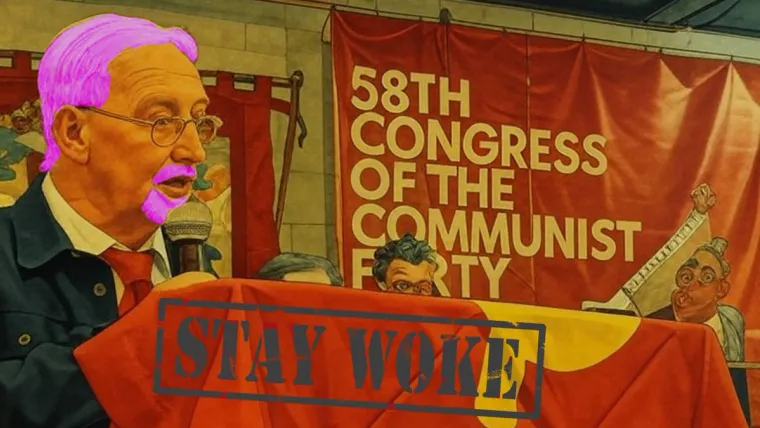
This weekend, the Communist Party of Britain held its 58th Congress at Wortley Hall in Sheffield. With recent Morning Star editorials hinting at a change in line after 75 years of unconditional support for the Labour Party; with the incumbent leader Robert Griffiths preparing to step down after 27 years as General Secretary; and with a rewrite of the party programme, Britain’s Road to Socialism (BRS), on the horizon; communists in the party who have been rightfully frustrated by its stagnation and decay held a cautious optimism that this Congress would finally mark a step forwards for the organisation and for communism in Britain.
But after the events of this weekend, we can only conclude that those hopes have been well and truly dashed. The party now seems to be moving towards a new normal that is just as bad, if not worse, than the old one.
The wider tendencies within the organisation can be identified not only through how the votes went at Congress, but through the far more elucidating pre-Congress materials which included a list of every amendment and resolution submitted by the membership and a line in red explaining the leadership’s recommended response. At Congress, almost every recommendation from the leadership was followed to the letter.
This either means that the leadership and membership are almost entirely aligned on all issues, or that any significant opposition was crushed before the vote. Although the Executive carried out plenty of undemocratic manoeuvres to prevent the more subversive resolutions and amendments from reaching the floor, usually in the interests of “time” or due to “error,” based on the votes which were held, it is clear that there is not any significant opposition from the membership to the CPB status quo.
As we mentioned in our recent video essay, one of the CPB’s worst crimes against workers in this country has been its uncritical support for the Labour Party at every general election since 1951. This position is rooted in the revisionist BRS which supports a reformist electoral path to power, rather than a revolutionary one. Perhaps there could be some justification for this if the CPB made any significant contributions electorally, but at the last general election, it received fewer votes than nearly every other socialist organisation in the country, and spent nearly £50,000 for the privilege. The fact that this money largely comes out of donations from comrades who have died, comrades who leave their entire life savings to the CPB out of a sadly mistaken belief that the party is leading the struggle for socialism in this country, is all the more shameful. Indeed, the congress financial report exposed the fact that once these funds dry up, the party could collapse altogether.
By arguing that there can be no socialism in this country without securing an electoral majority through parliament, and that the Labour Party’s historic co-option of the labour and trade union movements gives it a critical role in this electoral struggle, the CPB has backed every anti-worker, imperialist government and opposition that has ever been led by this cancerous organisation: from Neil Kinnock to Tony Blair, and yes, even Keir Starmer.
Since the BRS centres on an electoral strategy to achieve power and since any work in the mass movement only serves this primary aim, it is not an exaggeration to claim that the CPB’s entire reason for existence in its current iteration is to prevent the labour movement from breaking with imperialist social democracy. Workers who would finally break with liberalism and are ready to build a communist opposition are instead shepherded straight back into supporting it, only with Marxist-coded reasoning.
But with Keir Starmer polling as the least popular Prime Minister in British history, even less so than Margaret Thatcher, and with social democracy fragmenting into new electoral alternatives in the shape of “Your Party” and the Workers Party of Britain, the CPB has been forced, sluggishly, at the last possible moment, to make some performative statements about changing course. But at Congress, any resolutions or amendments committing the party to a clean break were well and truly squashed.
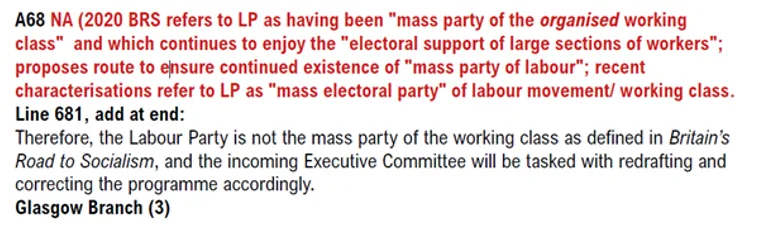
Amendments describing the Labour Party as an imperialist, anti-worker organisation and committing the CPB to support only socialist and anti-imperialist candidates at election time did not even reach the Congress floor due to “administrative errors.” And although a much milder amendment arguing that the Labour Party is not the mass party of the working class and the programme should be updated accordingly did reach the floor of Congress, it was comfortably defeated at the recommendation of the leadership.
Backing Labour to stop Reform
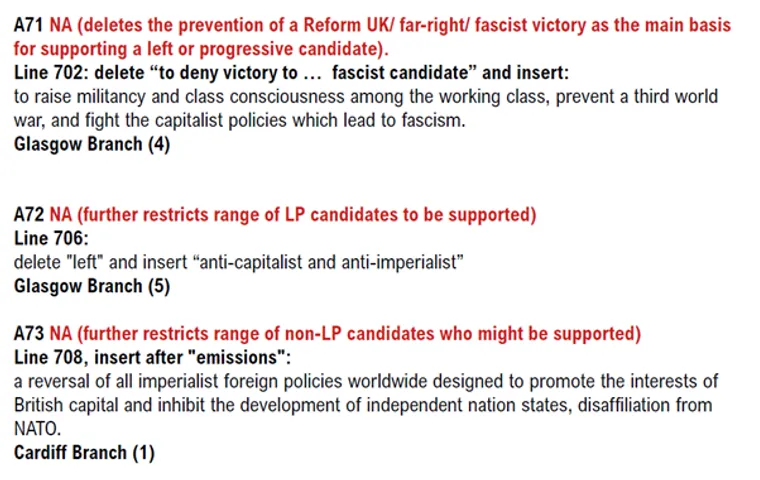
The CPB leadership’s justification for backing pro-capitalist, pro-imperialist candidates at election time were that they were the only alternative to a Reform UK government. Following in the footsteps of its Democrat-tailing sister party, the CPUSA, it is most likely that the political strategy of the CPB will change from “get the Tories out” to “vote for the candidate best able to keep out Reform.” This is not a new strategy, and the eurocommunists of the 1970s and 80s not only supported Labour candidates, but even Liberal Democrats, arguing that a liberal alliance against “Thatcherism” was necessary to keep out a “greater evil.”
But this is a wholly anti-Marxist positioning which falsely identifies the “left wing” of liberalism as an antidote to its “right”. Working-class support for Reform UK is based almost entirely on opposition to Labour Party liberalism, and particularly its support for mass migration and austerity, so a liberal alliance with anti-worker candidates can only assure a Reform UK victory. This is often presented as anti-fascist, but the rebuttal is the same. As the ideology of capitalism and the bourgeoisie, liberalism creates the conditions to make fascism inevitable, so supporting liberals is a pro-fascist stance. There is a foul irony in the fact that despite its historic formation as a split from the worst eurocommunist revisionists of the 1970’s and 80’s, the CPB should only end up parodying them a few years later by advocating a liberal alliance against Nigel Farage.
Debates on whether or not to support socialist candidates at election time were limited to discussions over the relationship with “Your Party.” Andrew Murray, a key advisor during the Corbyn years, has spearheaded uncritical support for this new manifestation of liberal-left social democracy, as well as others. In Murray’s own words:
[An issue informing next steps] must be the electoral strength of the Greens, parked on at least a slice of the left-of-labour vote. Can there — should there — be some form of pact? Without it, electoral results will be more meagre than otherwise.
Must an alternative be explicitly socialist?
Alongside Murray’s clarification that not automatically backing Labour should not be confused with backing a socialist or anti-imperialist alternative, Murray has openly attacked the Workers Party for its scepticism of Zarah Sultana and followed the liberal left in smearing its connection of mass migration to imperialism as “racist.” In a particularly sectarian and liberal criticism, he even accused George Galloway, a former comrade, committed socialist and anti-imperialist with an actual record of electoral success and popular support, as afflicted by “Trump Infatuation Syndrome”.
Clearly, the party has no interest in breaking with the middle classes of the liberal left and exploring genuine working-class electoral alternatives. After all, severing these former relationships would financially cripple the Morning Star which, having destroyed its working-class base, now relies on tailing the liberal left and the labour aristocracy for survival. And without the Morning Star, the CPB would struggle to justify its existence, even to itself.
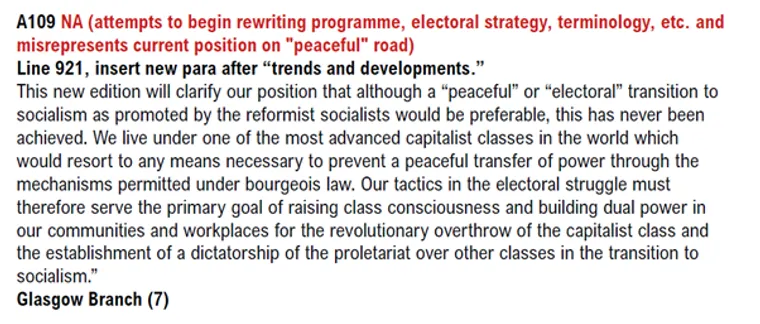
Likewise, the leadership refused to allow any input from Congress (nominally “the highest democratic body of the organisation”) into the rewrite of Britain’s Road to Socialism. The above amendment which would have committed the CPB to subjugate the electoral struggle to the struggle to build power in communities and workplaces, as well as return to Marxist-Leninist concepts such as “dual power” and the “dictatorship of the proletariat” also failed to reach the Congress floor as a victim of “administrative error”. This is wholly unremarkable when Robert Griffiths and his ilk are open critics of Marxist-Leninist concepts such as the dictatorship of the proletariat. Marxist-Leninists within the organisation should see this for what it is: confirmation that the CPB is not a democratic centralist organisation, and that the highest body of the party is not Congress, but the working group tasked with drafting future BRS editions on behalf of the leadership.
The Palestine Question and Multipolarity
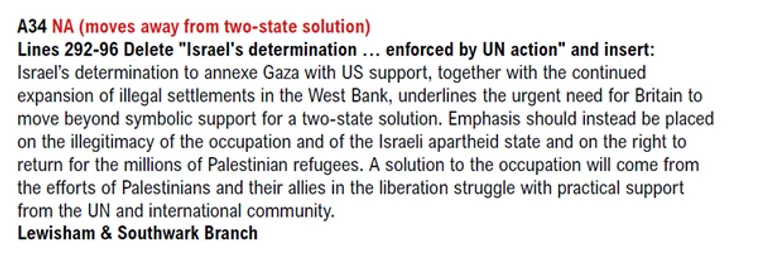
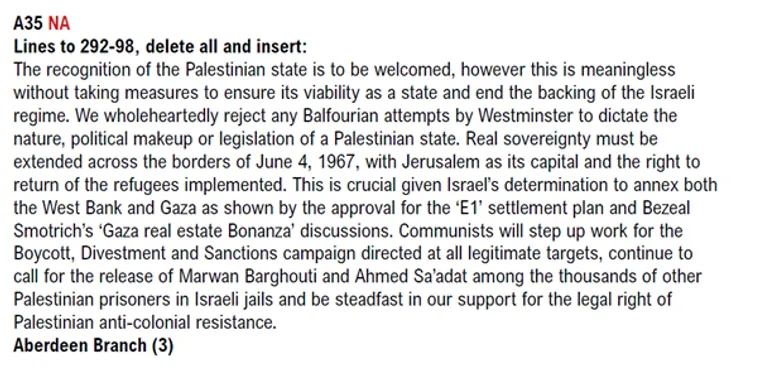
Two years into an open genocide, the CPB has continued to argue that a “limited” colonisation of Palestine is reasonable and that Palestinians returning to their homeland is an impractical demand, remaining loyal to the “two-state solution” position championed by imperialists throughout the world, not least of all our own Prime Minister. This tendency has been led by Mary Davis, an Executive Committee member who has spent the last two years of the genocide promoting an internal “Understanding and Combating Anti-Semitism Course” and writing articles in the CPB’s theoretical journal claiming that the relationship between anti-Zionism and anti-Semitism is “contested.” When even social democrats, from the Democratic Socialists of America to Zarah Sultana are now endorsing a one-state solution as the only genuine anti-Zionist position, communists should be rightfully disgusted by the CPB’s defiant defence of Israel.
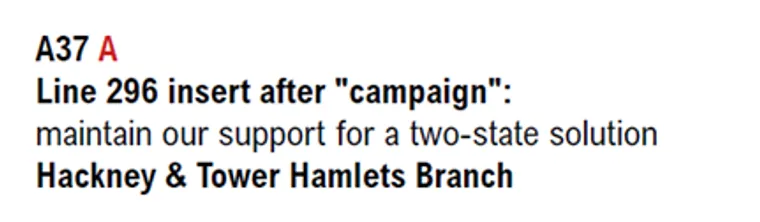
Again, amendments which explicitly challenged this position were buried, while a Zionist amendment from Mary Davis’ branch was recommended for acceptance with no debate permitted. Discussions on the Palestine question were also preceded by an international delegate from the Communist Party of Israel who spoke passionately in favour of the Zionist occupation at the behest of the CPB leadership.
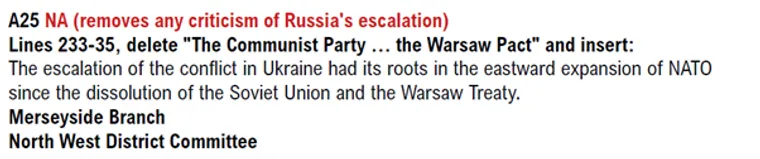
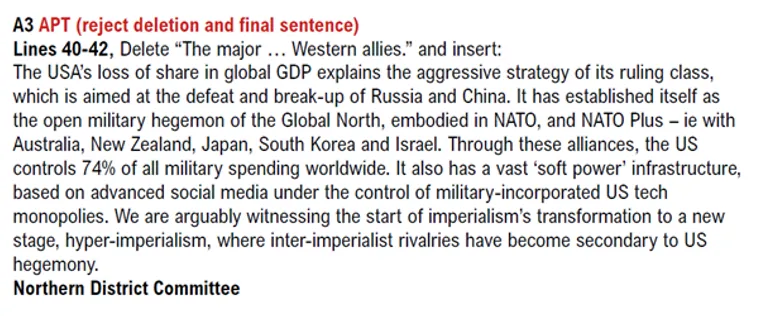
Any movement towards recognising the end of US hegemony and a multipolar world as progressive were also well and truly crushed. One amendment by the Northern District Committee which included a line arguing that inter-imperialist rivalries have become secondary to US hegemony was altered to remove this line. Likewise, support for Russia’s defense of the partisans of the Donbass was dismissed as imperialist Putin apologism, and support for Iran’s progressive defense of Palestine was smeared as “misogyny” and “anti-communism.” To some, this may seem like a lesser issue, but communists who are unable to hold multiple contradictions in their head when it comes to geopolitics will inevitably choose the side of imperialism and war. The Palestinian resistance praises Iran for defending their country and calls on it to go further, but of course, they should have checked with the CPB before indulging in such “misogyny.”
Bureaucracy and Corruption
It should be clear from Congress proceedings that any movement towards a Marxist-Leninist line is held in check by an unshakable bureaucracy that digs its claws into the organisation at every level. One attempted challenge to the bureaucracy in favour of cutting the bloated committee down from 32 members, a move which would have theoretically given more strength to a Marxist-Leninist opposition, was comfortably defeated. Indeed, after deliberations, the bureaucracy was expanded even further to 33.
Most Marxist-Leninists running for the leadership were excluded from the recommended list (or, in the case of one member, undemocratically suspended to prevent them from running). Formally, the leadership offered to listen to arguments in favour of including or removing nominees from this list, but in practice, all deputations were ignored. In the words of Turkish revolutionary Ibrahim Kaypakkaya:
Those who are factionalist and divisive are those who wish to implement the most extreme democracy for themselves, violating the principle of centralism, while wishing to implement the most extreme centralism on Marxist-Leninists. The bourgeois leadership has demonstrated with all these particularities a typical example of factionalism and divisiveness.
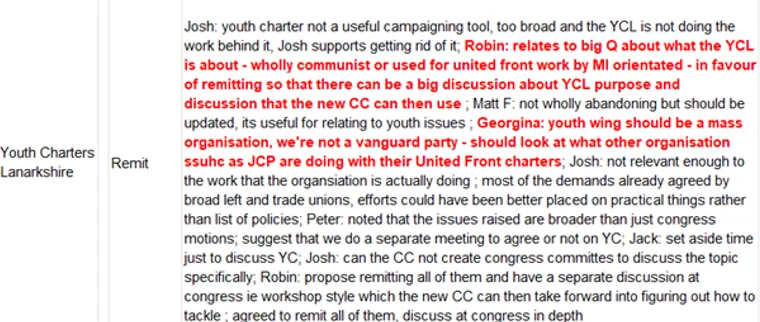
It is abundantly clear that an entrenched leadership faction make Marxist-Leninist advance within the organisation impossible, but the leadership, many of whom are in their 70s, are well aware that they will not live forever. They have therefore begun the necessary work of handpicking their successors. A quarter of the Executive Committee were replaced at this Congress, all directly chosen via the recommended list. It is these replacements who will now be leading the charge of liberalising the party. With young up-and-comers like YCL General Secretary Georgina Andrews openly calling for the youth wing to abandon Marxism-Leninism and usher more liberals into the organisation, it is clear that the CPB plans to follow the course of the PCF and CPUSA, growing bigger by abandoning Marxism-Leninism and the working class entirely.
A congress that changes nothing
It is clear from this congress that the politics of the CPB have not changed and are in no position to change in the future. This, despite some embarrassing rebranding efforts under a new hammer and sickle designed by Eric Gill, a notable sexual deviant known for his incestuous relationships with his sisters and for bestiality against his pet dog. Could there be any more fitting a symbol for the perversion of communism by this latest iteration of the CPB?
And despite being riddled with Zionism, despite tailing the most reactionary elements of the labour movement, despite being proved time and again that Marxist-Leninists in the organisation are crushed at every turn, despite the CPB driving the reputation of communists into the ground, some communists still remain wedded to the idea that the CPB is the only way forwards.
To those who hold greater hostility towards airing dirty laundry than actually cleaning it, whose tribal sectarianism means greater hostility towards the Marxist-Leninists who split from their organisation than the anti-communists within it who undermine them, we hope this latest congress will be a wake-up call.
Does a historical legacy within the communist movement guarantee that an organisation will carry communism into the future? If an organisation practices open recruitment of liberals while class-conscious Marxists are crushed or become demoralised and move elsewhere, what is the general tendency of the organisation as a whole? Dialectical materialism only has one answer to these questions.
The working class has waited 75 years for the CPGB and CPB to get their house in order, but it will not wait any longer. While the Communist Party of Britain and other sects continue to disgrace communist politics, Marxist-Leninists outside of the CPB are organising and developing. The fact that a new communist movement is emerging and the old one will be swept away is a Darwinian inevitability.
To those good comrades reading this who agree with our analysis: Will you retreat to the safety of local branch, YCL, or trade union activity; fall out of activity altogether; or consider an alternative? And if that alternative is being built right now, will you stand in the way, wait passively at the side lines, or help lead it yourselves?
To those who are still not willing to leave the YCL and CPB, RED WAVE is a cross-party initiative aimed at building Marxist-Leninist unity in Britain, and we extend a hand regardless, but we are convinced that it is those comrades who are ready to join us outright that will be at the forefront of our movement.