
Jamie Rowe and Sami Hadid look at the US-led peace negotiations in Ukraine, and argue that US withdrawal is more about delegating to imperialist lackeys in Europe, while the US focuses its military aspirations to other parts of the world.
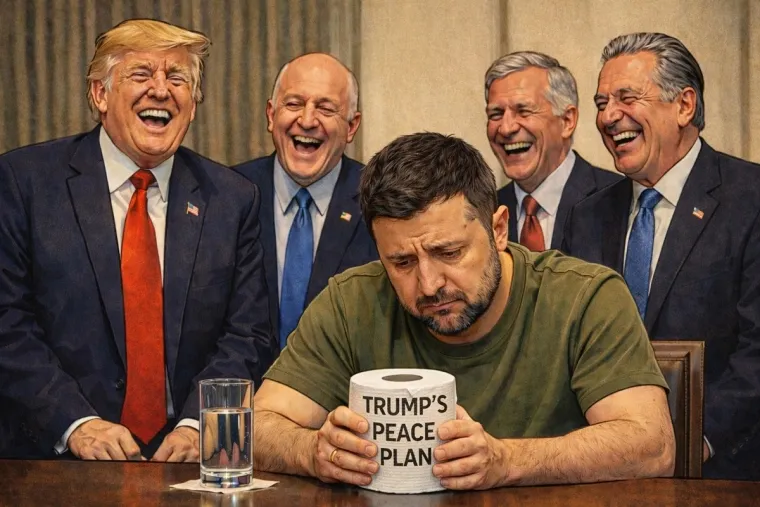
It’s been nearly four years since Russian troops marched into eastern Ukraine as the opening salvo of the Special Military Operation. This was the result of nearly a decade of failed diplomacy, covert operations and civilian massacres by the Ukrainian state against its ethnically Russian population in the Donbas. This region had declared independence from Ukraine way back in 2014 following an illegal and Western-orchestrated coup against an elected government committed to neutrality.
The United States government then offered cross-party support for escalating the conflict in the following years, from selling 150 Javelin anti-tank missiles to Ukraine during Trump’s first presidency in 2019, to backing an increase in shelling of the Donbass under Biden in 2022. The Russian SMO was also pre-empted by a build-up of 120,000 Ukrainian troops at the border of the Donbass the month before.
Fast forward past three years of a brutal attrition conflict in which the Russian armed forces have held a decisive upper hand, and the United States has finally been left with no other option than to seek a diplomatic resolution to the conflict. However, appearances can be deceptive without a proper understanding of the “peace plan” proposed by the United States, as well as without contextualising the Ukraine issue within the broader imperial strategy that seeks to maintain the US’s rapidly declining hegemony throughout the world.
The US pivot away from Europe
In 2011, the Obama administration announced its Pivot to Asia, thereby reorienting the focus of American foreign policy from the Middle East and Europe (which has been under significant American influence for the better part of a century) to containing a rapidly developing China, the current citadel of socialist construction in the world. Since then, it has been clear that the United States has been preparing for war with China through its proxy in Taiwan, urging both Taiwan and the European Union to build up their military power by 2027, which appears to be a deadline set for a world war in full swing.
An increasingly militarised Europe has also opened up the United States to begin transferring resources away from the war with Russia to other parts of the world. In this context, Trump’s peace plan looks far less like conciliation with Russia and more like an act of delegation by the imperialist hegemon. This was openly referred to by Trump’s Secretary of Defence Pete Hegseth back in February of this year when he announced that “Europe must [now] provide the overwhelming share of future lethal and nonlethal aid to Ukraine” as part of a “division of labour that maximises our comparative advantages in Europe and the Pacific.”
Taiwan as a second front
On the Taiwan question, the US administration may greenlight the President of Taiwan, William Lai to hold a referendum on Taiwanese secession to provoke China into an excuse for direct military engagement. This is a vote which would likely be won by the ruling, Democratic Progressive Party, which has long been the primary vehicle for the US-backed Taiwanese nationalist movement.
The government in the mainland will then be forced to intervene to prevent the secession of a historically Chinese territory over to de facto US control, leading to direct conflict with the US, with imperialist alliances such as AUKUS, and with US puppet states such as south Korea. At the same time, the Europeans, having built up their military assets, could find an excuse to invade the Russian Federation, keeping the Russians occupied on the European front to prevent them from coming to the aid of their comrades in the east. Although China is highly unlikely to be bested in military conflict with an ailing empire—its drones would blacken the sun if need be—this is an outcome that must be prevented at all costs as it would lead to a huge loss of life in both Taiwan and the world.
The issues of Taiwan and Ukraine are very similar and interlinked on the world stage. Both are proxies of the United States which are being used as launch pads for wars against its competitor civilisations. Further, one war cannot exist without the other. The weakening and destabilising of Russia through Ukraine is essential for the war against China to stand a chance. Under the leadership of their respective presidents, the two nations have forged ever-deepening ties. Russia is one of the world’s largest oil exporters, and China is one of the largest oil importers in the world, and China has increased its supply following the sanctions imposed on Russia by the European Union.
Together, they have also spearheaded the growth and development of BRICS, which is now working to develop an alternative currency to the dollar within international trade and includes not only the original five member states, but also Iran, Egypt, Ethiopia, and the United Arab Emirates. This is a sign that the oil-producing nations of the Middle East are turning to BRICS and away from trading their oil exclusively in the US dollar, weakening its status as the world’s reserve currency. It can therefore be seen why Ukraine is an important player in the broader US strategy on its road to war with China.
US pressure on Venezuela and Cuba
When analysing the international situation, we should always ask ourselves how events benefit or hurt the interests of the United States as the world hegemon. For example, the US’ imperialist actions in the Caribbean, relying on CIA-coordinated air strikes rather than another catastrophic ground invasion like Vietnam, can and should be seen not only as an ideological need for US capitalism to topple the socialist Venezuelan government of Nicolas Maduro, but also as part of preparations for the upcoming war against China.
Venezuela is the country with the largest oil reserves on the planet, and despite its struggling production and export industry, it exports oil to both Iran and China. Another state almost fully reliant on Venezuelan oil exports is Cuba, which recently refused a Russian offer of oil in favour of imports from Venezuela. Removing the Venezuelan government from power would worsen Cuba’s already collapsing energy situation, creating the conditions for the collapse of a state the US has been trying in vain to topple for 70 years. Or, if it chose to import from Russia instead, this would take oil supplies away from China, while Israel almost certainly blocks an alternative supply from Iran.
What the peace deal is really for
It is clear that the Ukraine peace deal that is now being proposed by the Trump administration is nothing to do with the peaceful interventions of conservatives against liberal and leftist warmongers. After all, the conflict has only been continued by Starmer after its start under the Tories, and both Boris Johnson and Reform UK have been bankrolled by the same pro-Ukraine donor, Christopher Harborne to grease the gears of the war machine.
The reality is that the deal is only coming after the administration was hit by the stark realisation that, in this moment, the war in Ukraine cannot be won. A freezing of the conflict allows Europe to build back its arms stockpile and expand its military capabilities, which in turn frees up US resources currently stationed in Europe for other theatres, and European leaders will be meeting in Paris on the 6 January to discuss next steps.
Once the situation has stabilised and Ukraine has recovered (if possible, considering its huge demographic decline in the last three years), the fires of war can be relit in Europe. Since the Russians continue to have the upper hand, however, it is unlikely that they will agree to any freezing of the conflict along the current line of contact. Ukrainian entry into NATO and the European Union remains a Russian red line, and the Russians have also come forward with the suggestion of limits to be placed on Ukrainian military capabilities.
In his New Year speech, Zelensky also rejected the possibility of withdrawing Ukrainian troops from the eastern Donbas, despite Russia occupying the vast majority of the territory. On the other side of the conflict, Putin used his speech to praise the heroes of the SMO, while Kim Jong Un hailed the “invincible alliance” between Pyongyang and Moscow.
As we head into 2026, the world finds itself on the brink of a new world conflict propelled by the United States’ quest to maintain its imperial hegemony, while the People’s Republic of China stands as the leader of a new world struggling to be born. Despite all its efforts, US actions around the world can only result in the hastening of its own decline, as the nations of the world are forced to choose between imperialist domination of their lands or a new and more equitable global order. Under these circumstances, the situation we face is nothing short of a choice between the past and the future.