
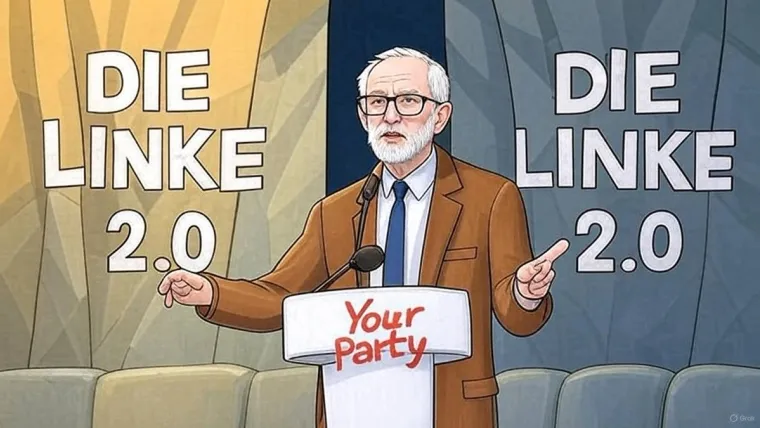
It would be hard to find a British socialist or communist in recent years who did not, at least at one point in their political awakening, have a soft spot for Jeremy Corbyn. His tenure as leader of the Labour Party brought out millions of people to vote for someone attempting to deliver pro-worker reforms to the British working masses, albeit with a significant number of imperialist concessions. These Corbyn years were ultimately a failure, exposing the impossibility of achieving socialist advance within the Labour Party, but they also made Corbyn the de facto leader of the mainstream British left. Naturally then, when Zarah Sultana, after much anticipation (and pressure), finally announced that she and Corbyn were to co-found and lead a new nominally socialist party, excitement exploded.
Within weeks, there were 800,000 sign-ups to the supporter form which seemed to show evidence of something historic, with at least the seeds of potential for a mass organisation that could attempt to address the issues facing British people. Instead, these hopes were quickly dashed by months of bitter factional infighting, feuds over membership portals, alienation of “social conservatives,” mismanagement of vast sums of money, and a conference that seemed more like a disorganised clown show than a serious political venture.
The confusion and opportunism continued after the conference as well, with Zarah Sultana calling for the ”nationalisation of the entire economy” in an interview with Owen Jones. This was clearly an attempt to rally around her the many Trotskyist micro-sects who circle like vultures around this new party, while at the same time making it painfully obvious that she has no real clue what a strategy for achieving power entails. Far from being a galvanising position, calling for “full nationalisation” or “revolution now” fails to bring workers and small business owners closer to a socialist consciousness or towards supporting the scale of economic transformation we need. Instead, it will only serve to alienate them even more from a party that is already perceived to be out of touch with the public and filled with Londoners with no real idea about the state of the country or any serious capacity for leading it. Of course, capitalism is capitalism and socialism is socialism, but messaging is important in these early, pre-revolutionary stages, and it’s difficult to have much faith in a leader who can be humiliated by Owen Jones of all people.
Despite the blame that can be placed on Corbyn, Sultana and those around them, we shouldn’t look at the wild mess of logistical failure and dismiss it as mere incompetence by the leaders of this new party. The problems faced by Your Party remain structural ones that exist because building a broad church organisation of ‘progressives’, old trade unionists, and liberals, alongside genuine and committed anti-imperialists and socialists, can only be a recipe for a hostile take-over by the interests of the ruling class (as in the case of the Labour Party), or a complete degeneration into factional infighting, feuds, outrage over ‘trans-liberation’ and other left-liberal issues as a result of the cranks and narcissists currently dominating the mainstream left and holding the working class hostage in its own organisations. The result was another fringe, cult-like party paralysed by its own lack of definition. At the time of the party’s founding, what was left of the 800,000 sign-ups was merely an audience, left to witness the horrific spectacle of the conference and the events preceding it unfold in slow motion, rather than an actual committed membership ready to push forward a genuine anti-imperialist and socialist platform. By the time the conference finally came around, there was no discipline, no strategy, and no cadre to lead: only a vacuum filled by factional opportunism.
Your Party is unlikely to survive the next few months if it fails to readdress its fundamental organisational strategy and the alliances it forges. The party’s founding documents state the intention of building up the party in workplaces and working-class communities, as well as support for genuine anti-imperialist positions. All this is well and good in words, but when it comes to deeds, the leadership has ignored calls made by working-class communists, socialists and anti-imperialists for Your Party to ally itself with advanced working-class organisations such as the Workers’ Party which would help root it among the masses and maybe even correct some of its worst instincts.
Instead, they have aligned themselves with the middle-class Greens: a pro-open borders, pro-EU, pro-NATO, imperialist, warmongering and left-liberal organisation obsessed by the repulsive politics of identity. If they are genuinely wanting to fill the void left by the Labour Party, while at the same time countering the rise of Reform, they should have thought much more carefully about the types of alliances they wished to create. Unfortunately, but perhaps unsurprisingly, the cranks have won, and the vote for a collective leadership has handed the keys of this organisation over to the reprobates who will likely put the final nail in the coffin.
Your Party fails to understand that an organisation which can actually appeal to the working masses of this country needs to be an organisation that workers can relate to. It needs to champion the arguments for why we shouldn’t be funding foreign interventions and never-ending wars in Ukraine and the Middle East and should instead use those funds to rebuild our crippled infrastructure and broken healthcare system and lower the cost of living. It should also pioneer the argument for the UK to become a positive actor on the world stage. There needs to be a conversation about why having good ties with anti-hegemonic and anti-imperialist nations such as Russia, China and the DPRK can only be beneficial to the British people. It should commit itself to rebuilding British industry and bringing back high-quality manufacturing jobs. In short, it needs to put forward a coherent, anti-imperialist economic vision that will help fix the problems felt by the British working class.
Your Party makes it clear that what is needed is a disciplined, theoretically advanced political party based on democratic-centralist principles with a membership of dedicated and educated cadre that can go into communities, meet people’s needs, and put forwards a credible platform of change in working-class language. There is no chance of this space being filled by Your Party, but it could be an opportunity for Britain’s communists. A void remains in British politics, one that can only be filled by an organisation like the one above. A new, principled, non-opportunist, revolutionary party of the working class that can correctly analyse British conditions and place the anti-imperialist struggle at the forefront of its activities both at home and abroad. This party could become the head of the spear which, through a broad alliance of popular forces, actually takes the working class to power in Britain and initiates the programme of change that the British masses are desperately in need of, but perhaps are not yet in a position to voice.