
In Part II of our series on anti-communist tendencies, David Jarrett looks at British ultra-nationalism, arguing that while they may point to real problems in our decaying capitalist society, ultra-nationalists are bankrupt of solutions and more than happy to side with the elites. Read Part I here.
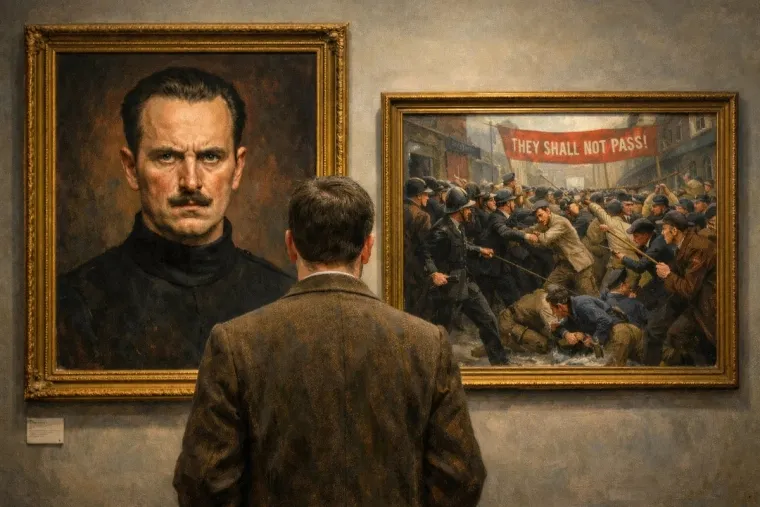
In under three months, RED WAVE has already become a beacon for those concerned by increasing working-class precarity in the UK, cultural nihilism and degeneracy, worsening mental health conditions, and a criminal, oppressive government, but communist patriotism is nothing to do with so-called “national socialism,” i.e., bourgeois ultra-nationalism. So, what’s the difference?
The first is in our analysis. The bourgeois ultra-nationalists (“ultras” for short in this article) typically focus their attention on the international phenomena of immigration, and—to a lesser extent—”international finance” and “malicious speculators”. Communists are concerned with these too, but there are two key differences. First, communist concern with these international processes is part of a more holistic critique of capitalism, with the primary focus being processes internal to the nation. Most famously, Marx’s case study of capitalism in Britain focuses on the historically violently-imposed property system which resulted in a monopoly ownership class on the one hand, and a landless proletariat on the other, compelled to serve the ownership class, and leading to the Dickensian conditions Marx analysed and ripening into today’s forms of rentierism, usury, and exploitation.
However, ultras do not have this more thorough critique of capitalism. Rather, for ultras, the overwhelming problem is foreign interference (with black, brown, and Jewish people often considered permanently “foreign”). While communists recognise that capitalism is international, we also recognise that it is not the case that the symptoms of capitalism would disappear if a purely national capitalism could hypothetically be established, as the ultras might have you believe.
Second, the communist concern with mass immigration is not that immigrants and their descendants are incapable of assimilating into Britain. However, we recognise that the ruling class sees the British working class as disposable and is happy to import workers—often oppressed in their own countries, including with the support of the British ruling class—instead of training Brits or paying decent wages. We also recognise that as the class war progresses, mass immigration will represent a challenge to the political task of working-class education, organisation, and mobilisation. Furthermore, it is in communists’ strategic interests to have a stable, loyal, patriotic population—dedicated to the betterment of Britain—with which to go about the hard work building a flourishing form of British socialism. Thus, in a post-revolutionary period of building a new socialist Britain from the embers of the old, it would be politically naïve to allow mass immigration. With all this said, in a pre-revolutionary situation, if we want to see an end to bourgeois rule, our only choice is to organise the whole working class, including immigrants, to take power from our corrupt leaders. It has long been recognised that division in the working class, including between natives and immigrants, benefits the ruling class.
This brings us to the difference in solutions. Ultras point to real instances of economic and social decay, but lacking a thorough critique of the class system, they are only prepared to propose—aside from remigration policies—bourgeois social democratic and protectionist economic policies. They are class collaborationists, which really means maintaining the oppressive and exploitative class system that breeds the forms of social decay they claim to be concerned by, such as idleness, nihilism, anti-social behaviour, crime, the prostitution/pornography industry, substance abuse, and so on. They show no interest in the communist perspective on addressing the issues, which is not primarily about specific policies but about the whole British working class—including black, brown, and Jewish members of the class—taking responsibility, organising collectively, and working together to take control of society. Of course, communists in all countries will favour some core policies in common, such as debt cancellation, job guarantees, and genuinely affordable housing for all. They will also likely favour certain policies for addressing any specific residual forms of degeneracy that are prevalent in their countries. But these are all downstream to the principle of control of society by the organised working class—something all bourgeois political strands, from liberals to fascists, have historically balked at.
At times, ultras suggest policies that superficially overlap with communist approaches, such as public ownership of certain industries. However, the devil is in the detail. A bourgeois approach to public ownership involves handsome compensation to private owners ultimately paid for by the working class in one way or another. Coal nationalisation in post-war Britain was paid for by taxpayer-funded, interest-bearing government bonds, and fascist Italy borrowed from bankers to finance takeovers of private banks’ stakes in failing, indebted companies, essentially bailing out the bankers and industrialists while simultaneously indebting the Italian public to the bankers even further. A communist approach is to simply expropriate the resources rightfully held in common by the country’s people, without compensation to the private usurpers. Put simply, ultras and communists have an incompatible approach to the property question, and ultras have a bourgeois approach completely in line with the interests of the rentier monopoly-ownership class.
In sum, while there is some superficial overlap in concern with social decay, ultras neither show a communist understanding of the problems, nor a communist approach to the solutions.