
In Part III of our series on anti-communist tendencies, David Jarrett looks at anarcho-capitalism, with thinkers like Murray Rothbard envisioning a fully privatised form of society with no traditional state. Read Part I here and Part II here.
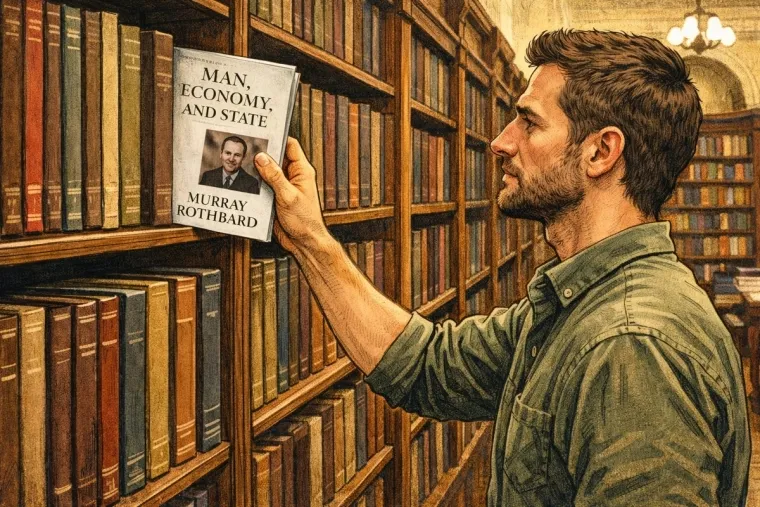
In the 1970s, Murray Rothbard outlined an approach to political economy known as anarcho-capitalism, a fully privatised form of society with no traditional state. The police, courts, roads, and all land would be privatised. With no traditional state, there would be no taxes, no public services, no government regulations, no welfare, and no traditional armies (although private “defence agencies” would exist). Rothbard’s anarcho-capitalism is worth thinking about for communists because it is an influential ideology, and it offers a simplified way of looking into bourgeois ideology more generally. While anarcho-capitalism may seem extreme, Rothbard is only taking the influential Lockean theory of justice in property (or Lockeanism) to its full conclusion.
According to Lockeanism—which originates with John Locke, arguably the founding thinker of liberalism—we own ourselves and our legitimately acquired worldly resources. The forms of worldly resources we are entitled to acquire are: (1) any previously unowned natural resources we labour on, (2) any resources we receive via voluntary transfer from a legitimate owner, and (3) any resources we receive in compensation or restitution for infringements of our rights. We should further note that, according to Lockeanism, once acquired, worldly resources become owned specifically as private property. We do not merely acquire conditional possession or use rights, for example. Many Lockeans temper these three acquisition rights by saying we should have low taxes to fund a minimal state, but Rothbard argued against any exceptions.
Following Locke, Rothbard argued that Lockean rights are natural rights, dictated by natural law. To simplify, the natural law claim is that there is a higher law than positive law (man-made law for specific times and places). There is a natural—or moral—law to which we have a duty. Positive law is only legitimate if it is compatible with this higher law. Thus, natural law was appealed to at the Nuremberg prosecution of Nazi leaders—there was a higher law than Nazi Germany’s positive law, which the Nazis were guilty of breaking. Anarcho-capitalists go so far as to say that social relations that do not adhere to Lockean rights theory are illegitimate.
Communists often reject the idea of natural law, but they are seriously mistaken in doing this. In fact, being a communist makes zero sense without at least an implicit adherence to natural law and natural rights: the implicit claim of communists is that bourgeois social relations are illegitimate, and that, when the time is right, the working class will be justified in using force to end the oppressive class relations that are sanctioned by bourgeois positive law. This position is inexplicable unless communists believe that there is a higher law that societies should adhere to. So, the debate between anarcho-capitalists and communists is not over an adherence to natural law per se. The debate is over the social relations acceptable according to natural law.
Similarly, communists often reject the idea of natural rights on the supposed grounds that they are a bourgeois construct. It is true that bourgeois states uphold bourgeois rights, and bourgeois apologists present these bourgeois rights as natural rights. However, there is no need to reject natural rights per se because we reject specific bourgeois theories of what our natural rights are. Rather, we can take a communist approach to natural rights. To do this, we can start by following modern natural law theorists such as John Finnis and Jonathan Crowe, according to whom to talk of natural rights is simply a modern way to talk of entitlements under natural law. For example, if Adam has a natural law duty not to enslave people, Bob has a corresponding natural right not to be enslaved. A communist approach to natural rights would be to outline an approach to entitlements which prohibits the emergence of class oppression based on the concentration of resources among the few.
It is worth noting that, in this task, there is a long history of European anti–private property natural law theory that communists would do well to learn from and build on. Perhaps most notably, Pope Nicholas III’s 1279 papal bull Exiit outlined that private property was illegitimate for Franciscans (the religious order of which he was protector). Franciscans had the right to use resources but not to take private proprietorship over them or alienate them permanently from the common. Prominent theologians such as Duns Scotus also outlined anti–private property natural law ideas. While the mainstream Church soon abandoned such perspectives, similar ideas remained popular until the early modern era among heretical religious peasant communities and sporadically influenced uprisings, including in England. John Ball, a cleric who inspired the 1381 Peasants’ Revolt, preached: “Matters cannot go well in England, nor ever will, until all things shall be held in common, when there shall be neither vassals nor lords…” During the English Civil War, radicals such as Gerrard Winstanley—leader of the Diggers movement—defended communism on natural rights grounds. At around the same time, the doctrines of natural law and natural rights per se came under fire from Ireton during the Putney Debates as implying opposition to private property. Thus, we see that natural rights doctrine became a tool of the oppressed lower classes and a scourge to the ruling classes.
It is unfortunate that the most popular natural rights theorists of recent times have been bourgeois theorists such as Rothbard. Communist approaches to natural rights essentially disappeared alongside the rise of vulgar materialism and atheism. Problematically, the vulgar materialist approach to communism fails to sufficiently engage with a crucial aspect of how most people think, namely that they are motivated and constrained by beliefs about rights—something bourgeois natural rights theorists such as Rothbard have played on. However, the bourgeois hold on natural rights theory is fragile, as can be seen from Rothbard’s work. It is beyond the scope of this short article to unpack Rothbard’s full argument for Lockean rights; however, I will point out that his central claim against communism is that, under communism, all resources would be owned by everyone, meaning that nobody would be able to do anything with any resources without prior permission from everybody else in the world. Rothbard’s argument overlooks the possibility of people simply being accountable to relevant communities for their resource use. Thus, communism is compatible with free, rational human activity and with multiple forms of possession, occupancy, and use rights over resources. Rothbard’s central argument against communism falls apart if one acknowledges this. It is in this context that today’s communists in Britain would do well to re-engage with the radical natural law and natural rights tradition. Such a re-engagement would not only help counter anarcho-capitalist ideas, but could also provide a basis for turning the working class against bourgeois thought more broadly—and, ultimately, against capitalism itself.