
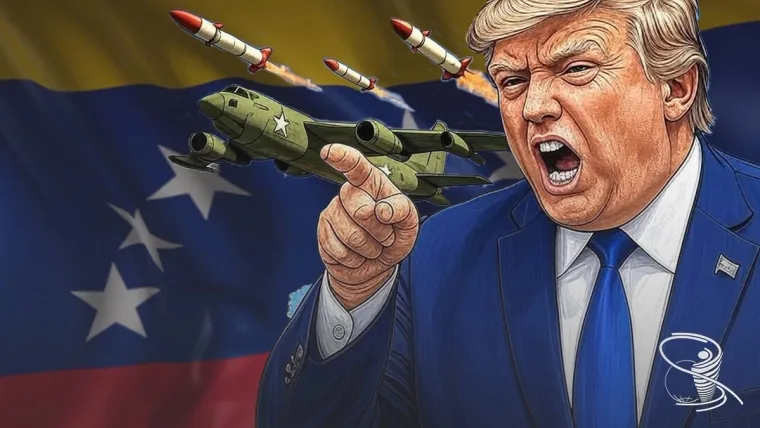
Despite positioning himself as the first president in decades to start no new wars, Donald Trump is bringing the United States dangerously close to another one, this time with Venezuela. The Independent reports that, as of the 12th of November, the world’s largest aircraft carrier, the USS Gerald R. Ford had arrived in the Carribean, joining eight other Navy vessels already deployed. Further, there has also been a bombing attack demo carried out with B-52 strategic bombers and F35 fighter jets.
Although the US has held back from carrying out any attacks on Venezuelan territory thus far, they have used their massive build up in the Caribbean region to target small fishing vessels leaving the Venezuelan coast, with the excuse that these are “narco-trafficking” vessels aimed at bringing narcotics into the United States. These extra-judicial attacks have now killed more than 75 people in 16 vessels since early September, direct acts of murder against the civilians of another sovereign nation.
To understand why the United States is preparing for a potential attack on Venezuela, it is important to study and analyse the Bolivarian revolutionary process that underpins the transformation that Venezuela has been undergoing since the election of President Hugo Chavéz in 1998.
The election of 1998 saw a socialist-oriented popular administration take power in Venezuela, promising a new, participatory democracy that would truly reflect the popular will of Venezuela. The Venezuelan Bolivarian constitution, approved and enacted in 1999 after drafting by a constituent assembly, guarantees the right to political participation, referenda, and the right to recall politicians who are deemed unsatisfactory by constituents. Venezuelan participatory democracy is one of the most advanced in the world, and over the course of the Bolivarian process, several building blocks to facilitate participation for the people have been constructed. Alongside popular referenda and social audit controls, multiple forms of economic and political participation have been and are in the process of developing.
One of the best examples are the communal councils, which form the unit cells of the communes. Communes are grassroots organizations that bring together ordinary people in specific territories. These establish a form of self-governance to manage the means of production owned by the commune, administering resources and holding legislative power. Many levels of organisation exist within a commune. There are communal banks, parliaments, and various committees which occupy themselves with the economy, sport and other aspects of society.
According to an interview conducted by Monthly Review with Ángel Prado, the Bolivarian government and the communal movement have a “synergistic relationship”. Political consultations have increased between the central government and the communes, a process in which communes hold assemblies to debate the pressing issues of the day. A voting process then takes place to select which of the problems is the most pressing in each commune. The central government then allocates funds for the execution of these projects. The commune alone shows the impressive level of participation that occurs in Venezuela.
Cooperatives also form an important part of the Venezuelan economy, ownership structures that are recognized and protected by the constitution. These involve direct worker participation, often applying the mechanism of one member, one vote.
It is not only the existence of a vibrant socialist and anti-imperialist experiment not far from US borders which infuriates the United States, Venezuela is also home to the largest petroleum reserves in the world, 5 times more than those of the US. Current production of oil is dominated by Petroleos de Venezuela, SA (PDVSA), a state-owned company. In 2017, the United States placed wide-reaching unilateral sanctions on Venezuela, tightening them again in 2019. This caused oil exports to heavily decline and ended in almost a complete cessation of oil exports to the United States, which was once Venezuela’s largest buyer.
In 2022, Chevron was granted a short-term license to form a partnership with PDVSA to produce and export oil and lower oil prices by increasing the supply on the world market. However, due to the sanctions, the benefits for the Venezuelan economy were minimal. Following Donald Trump’s re-election, 25% tariffs were placed on imports to the US from countries that imported Venezuelan oil to pressure China, Russia and India, among others, who had increased their trade with Venezuela despite US sanctions. Thanks to mainly Chinese business, oil exports from Venezuela are rising, and the Venezuelan economy saw a growth of about 8.5% in 2024.
There is therefore a cruel logic to the United States’ renewed interests in regime change in Venezuela. In the Caribbean, there lies a country which remains an example of genuine sovereignty in the region. President Nicolas Maduro remains committed to safeguarding that sovereignty from a US-backed opposition in bed with the worst international criminals on the planet. He has previously stated, “We reject the idea that, under euphemisms like “security” or the “fight against drug trafficking”, there should be an attempt to impose the old Monroe Doctrine that seeks to turn our America into a stage for invasions and regime-change coups to steal our immense wealth and natural resources.
We firmly reject the resurgence of the Monroe Doctrine and raise, in response, the Bolivarian Doctrine in defense of the independence, unity and emancipation of our peoples.”
The Bolivarian government is not alone in preparing for a defence of its territory. With it is a civilian militia of millions of people, ready to protect what’s theirs. The government is actively taking steps to arm this militia with rifles in preparation for guerilla warfare. Those who fall for Western lies about a Maduro “dictatorship” would do well to question why a government that supposedly fears its own people would actively provide them with the weapons which could be turned against them.
The birth of the new multipolar international system will slowly allow Venezuela to circumvent US sanctions, gradually reducing their effect. As more states become independent of the United States and their economic hegemony, this process can only accelerate.
When looking to Venezuela, it is the duty of anti-imperialists the world over to stand firmly with the Bolivarian government as a bastion of economic sovereignty for Latin America, understanding that the Bolivarian revolution is a process that is constantly changing and developing, and that is actively maturing in the face of mounting international pressure.
The Venezuelan people will not be threatened by the United States, and their love for their country will be the US’s undoing. As the United States withdraws support for a failed proxy war against Russia, another conflict will do nothing to save an American system in decline. A desperate attack on People’s Venezuela can only end in failure and hasten the rise of Latin American unity in response.
It is the role of anti-imperialists in the US and UK to cut through the propaganda and expose the economic logic of the US’s actions, as well as to build the leverage needed to jam up the war machine as best as we are able.
Long live the Bolivarian Revolution! Death to imperialism!